Demis Hassabis: The Biological Bootloader
Sebastian Mallaby's new book, The Infinity Machine, is finally out. I was fortunate to get an advance copy from him.
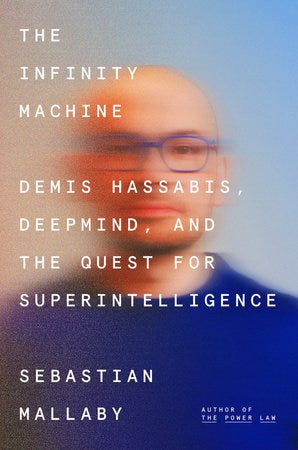
Reading through the book, I felt the puzzle pieces in my mind click into place. It wasn't the puzzle that's been at the center of my mind, but an extension of one that was starting to coalesce in the background, thanks to my recent musings on superintelligence.
Interestingly, Demis was a neuroscience PhD due to his belief that the brain is the ultimate machine that computers should emulate. In contrast, David Silver, his friend, co-founder, and classmate at Cambridge, went off to do a PhD in Computer Science under Rich Sutton in Alberta.
In a way, Demis is the embodiment of the infinity machine, defined as a machine that can take in an infinite amount of data and understand the complex and dynamic aspects of the world. Demis was the product of competitive games, starting with chess. His innate creativity then allowed him to imagine a game with more depth and human-like characters that feel hunger, boredom, and nausea. Theme Park was the embodiment of this.
He took a glance into the world of physics and mathematics, but didn't buy into the principles of deduction. To him, induction seemed to be a better source of intelligence. In a way, it's a method of getting around energy barriers, hacking the system to avoid brute force compute (and hang-ups around logic and axioms) that may lead to progress but in an unknown timeframe.
Why wait when you can skip the line entirely?
I realized, while reading the book, that this type of "shortcut" has been the driver of breakthroughs at Google DeepMind.
- AlphaGo explores but knows when to exploit or abandon, rather than committing to an endless branch of a Monte Carlo tree
- AlphaFold exploits Levinthal's Paradox and cheats brute force physics by turning protein folding into a pattern recognition and spatial reasoning task
- AlphaProof, while still being tinkered with, has been superseded by a reasoning Gemini model that does not require an external theorem prover
If we consider Demis to be an archetype of human intelligence, perhaps we can define human intelligence as the ability to take shortcuts1 or the ability to do more with less: Feed it books like Gödel, Escher, Bach, Ender's Game, and Asimov's Foundation series, sprinkle in a dash of hypercompetitiveness and the love for Liverpool, and you end up with a Demis Hassabis, who then creates in silico intelligence.
A true biological bootloader of artificial superintelligence, if you ask me.
The Infinity Machine is a classic Mallaby piece. I highly recommend it.
When we solve sudoku puzzles, we may write two numbers in the corner of a box to remind us of the possible answers. We learn to do more with less. Newton had to work with assumptions in order to come up with his three laws of motion. Even with an opaque view of the world, we learn to blast past the energy barrier.↩